The right upsell app helps a shopper complete a better purchase: a compatible accessory, a useful refill, or an upgrade that actually fits their needs. Adding more offers is not automatically better. An extra pop-up can also interrupt the purchase you already had.
This guide compares eight Shopify apps across product recommendations, cart drawers, bundles and post-purchase funnels. The aim is to help you shortlist by workflow, understand the bill and identify questions to test—not to declare a universal performance winner.
K1 Apps and Digismoothie are content partners; Candy Rack’s featured placement is part of that collaboration.
How we researched this comparison
Prices are in USD; monthly plans are shown unless stated otherwise.
We compared current Shopify App Store listings, developer documentation and a selected mix of recent and lower-rated written reviews, reading developer responses where available. The linked review examples highlight practical questions about setup, support, billing and compatibility.
This is a research-based comparison, not a hands-on benchmark or a survey of every merchant. Reviews describe individual stores and sometimes older versions; neither a complaint nor a developer response establishes how the app will behave in your store. The screenshots show public listings captured during our research.
Shopify upsell apps at a glance
| App | Shortlist for | Billing basis to understand |
|---|---|---|
| Candy Rack | Several offer placements plus a built-in slide cart | Store-order volume |
| Kaching CartDrawer | A branded cart drawer with add-ons and rewards | Order-labelled subscription tiers |
| Essential Upsell & Cross Sell | Product recommendations with revenue-based scaling | Added revenue; automatic plan changes |
| Selleasy | Multiple campaign formats with a small free starting allowance | Campaign and AI allowances by plan |
| ReConvert | Funnel controls, targeting and automated setup | Store orders or upsell revenue, as described by the developer |
| Frequently Bought Together CBB | Complementary-product bundles and curated recommendations | Free feature limits, then order-volume tiers |
| Aftersell | Post-purchase funnels, with separate pre-purchase options | Product package and store-order volume |
| Honeycomb | Offer funnels and split tests | Monthly funnel views |
What to compare before installing
Choose the placement first. Product-page recommendations, cart add-ons, checkout blocks and offers after payment solve different problems. A one-click post-purchase offer is also different from a thank-you-page offer that starts another payment step.
Compare the whole bill. A development-store plan is not a free live-store plan. Store orders, app-added revenue and funnel views are different charging units. Check the tier your store would actually enter, not just the smallest price on the listing.
Define success before launch. Measure incremental profit, checkout conversion, refunds and shipping costs alongside app-attributed sales. A relevant accessory sold at a healthy margin matters more than a larger cart created through heavy discounts.
1. Candy Rack — multiple placements and a built-in slide cart
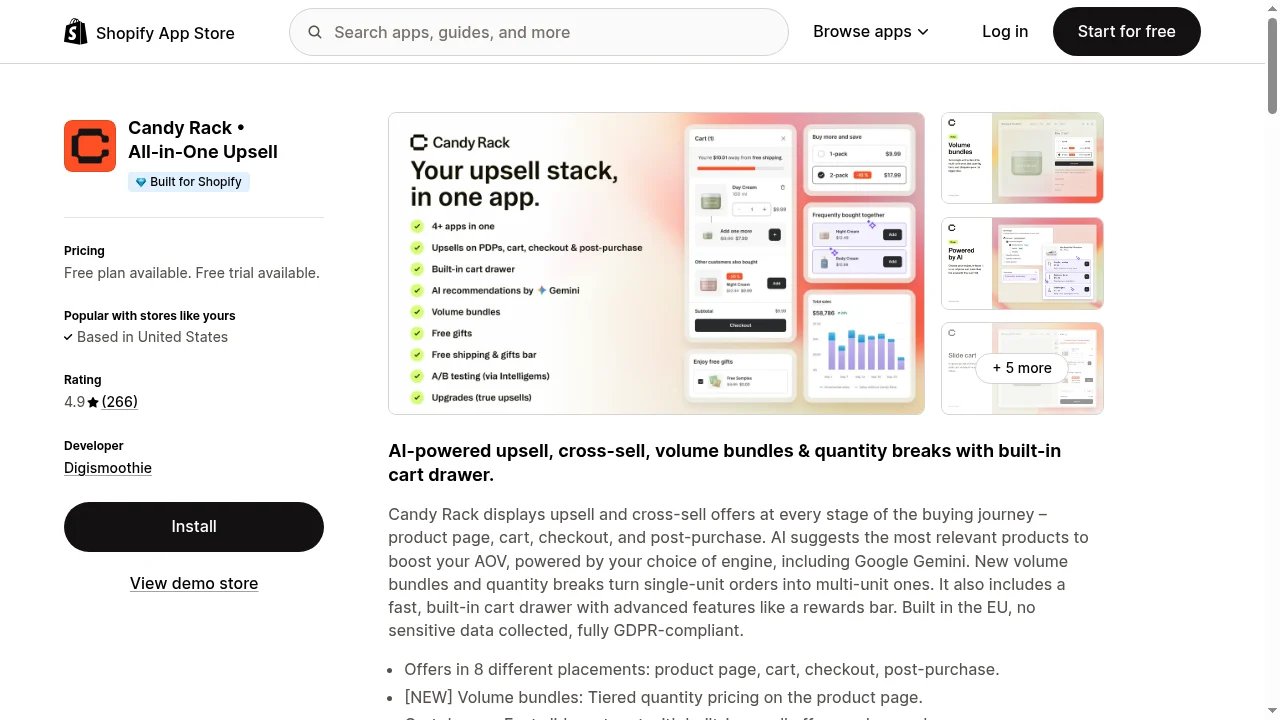
Source: Candy Rack on the Shopify App Store.
Candy Rack combines recommendations, upgrades, quantity offers and a slide cart for merchants who want to manage several stages of the purchase journey under one subscription.
- Eight placements: Add-to-cart product-page pop-up; embedded product-page checkbox and button layouts; Checkout-triggered cart pop-up; Candy Rack slide cart; checkout; post-purchase; and Thank you/Order status pages.
- Manual selection of up to ten products per offer, or recommendations via Candy Rack AI, Google Gemini or Shopify’s Product Recommendations API. AI can also write offer titles and descriptions and is included in every plan at no extra charge.
- Volume bundles with up to ten quantity-pricing tiers, a slide cart and rewards bar, and linked add-ons removed with their associated product.
- Intelligems offer A/B testing for product-page pop-ups, embedded product-page offers and cart pop-ups—not checkout or post-purchase. Intelligems price tests are reflected in offer prices.
Monthly plans scale with online-store orders: Lite $29.99 for 0–50, Starter $39.99 for 51–200 and Growth $59.99 for 201–500. These tiers include unlimited upsell orders and revenue. See higher-volume pricing.
The free plan is for trial and development stores. The listing advertises an 8-day trial and a 60-day money-back guarantee; check the applicable conditions before subscribing.
Only checkout offers require Shopify Plus. Post-purchase and Thank you/Order status offers work on all Shopify plans; the latter require the new pages to be published. Embedded in-cart offers require Candy Rack’s slide cart; third-party drawers can use the cart pop-up. The Intelligems integration is enabled by default with no extra Candy Rack fee, but Intelligems bills its own subscription separately. Pre-order, deposit and subscription compatibility still needs store-specific testing.
The sampled positive reviews repeatedly praise responsive support and help with store-specific adjustments. One merchant describes custom coding to achieve their intended setup. The sampled critical reviews focus on free-plan and trial expectations; in a July exchange, Digismoothie apologized and offered a free subscription for the non-live store. Confirm your store's eligibility rather than interpreting “free plan” as unrestricted live-store access.
Our take: shortlist Candy Rack for breadth and a built-in cart, while checking the store-order bill and the exact placements you need.
Explore Candy Rack’s product page · Feature documentation.
2. Kaching CartDrawer — cart-focused upsells and rewards
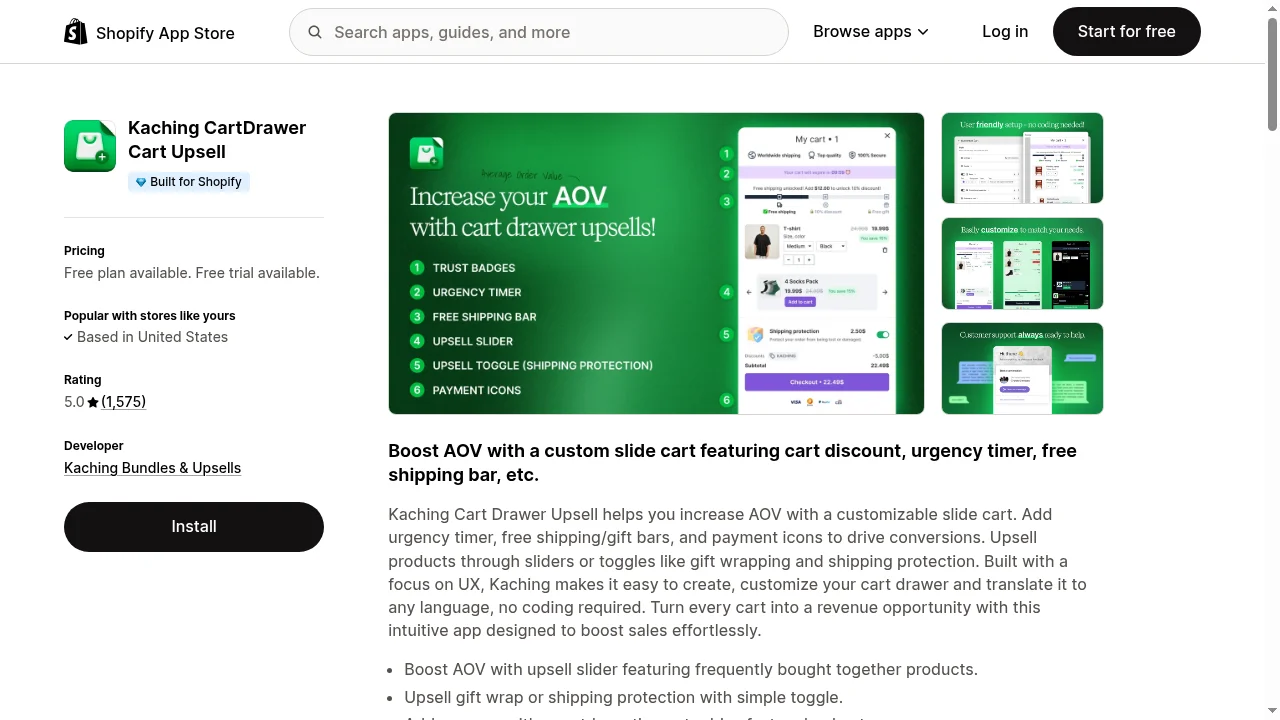
Source: Kaching CartDrawer on the Shopify App Store.
Kaching CartDrawer focuses on the cart itself. It combines a customizable slide-out cart with recommendations and purchase incentives, making it relevant when the existing cart—not the post-purchase funnel—is the part of the store you want to improve.
- An upsell carousel for complementary products inside the cart drawer.
- Optional add-ons such as gift wrapping or shipping protection presented through toggles.
- Free-shipping and free-gift progress bars, plus a countdown timer.
- Brand styling, payment icons and translation controls for the cart experience.
The App Store shows plans labelled 99 orders/month at $9.99, 199 at $14.99 and 499 at $24.99. The displayed plans list the same core cart features and a 14-day trial. A free plan is available for development stores.
Confirm which orders count toward your tier and the price beyond the displayed volumes. Do not mistake the development-store allowance for an ongoing free subscription on a live shop.
This is a cart-drawer app, not the same product as Kaching's separate bundle or post-purchase apps. Check how it replaces your theme cart and handles existing discounts and cart add-ons. Countdown and reward messaging should reflect genuine offer conditions, not create misleading urgency.
Recent written reviews praise support and the cart's appearance. One October reviewer specifically highlights mobile presentation and matching brand colors. Critical feedback includes slower-than-expected support and confusion about free access.
Our take: evaluate it when you need a branded cart with recommendations and rewards, rather than an all-stage funnel platform.
3. Essential Upsell & Cross Sell — recommendations with revenue-based scaling
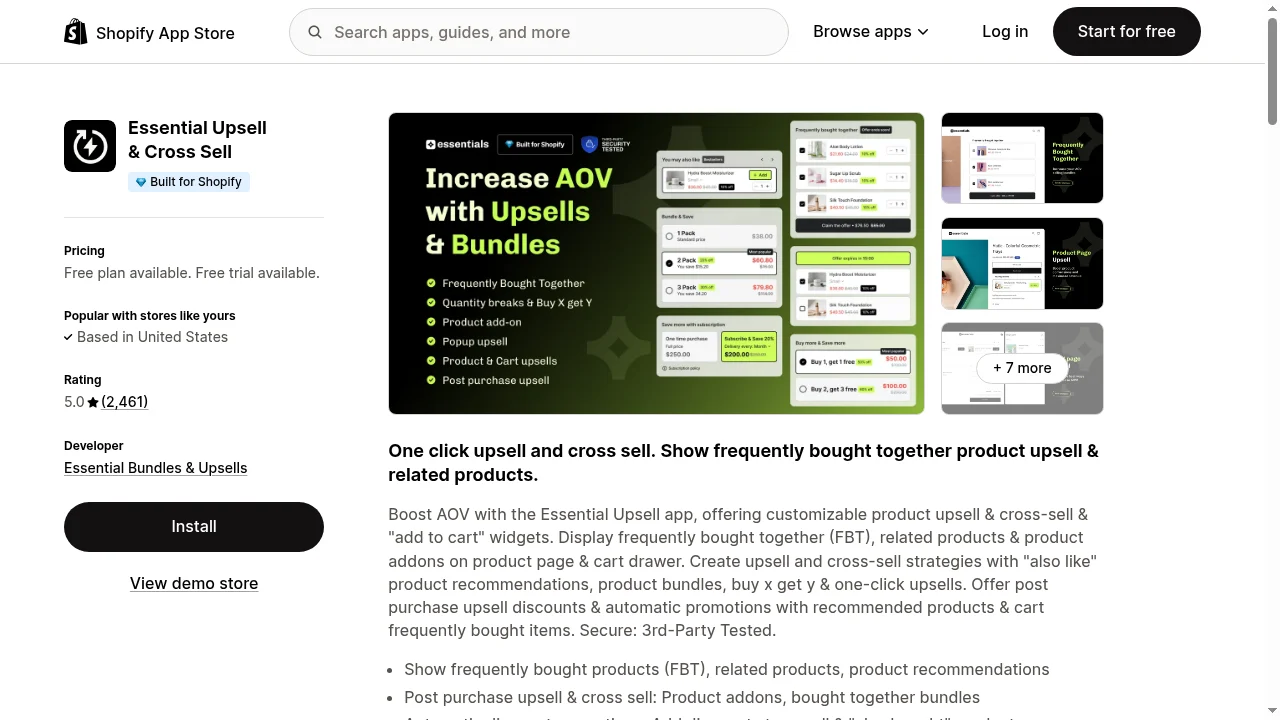
Source: Essential Upsell & Cross Sell on the Shopify App Store.
Essential combines related-product recommendations, frequently-bought-together offers and add-ons. Its pricing model is based on revenue added through offers, which makes understanding attribution and automatic upgrades an important part of evaluating the app.
- Frequently-bought-together and related-product recommendation widgets.
- Product-page and post-purchase offers, with cart offers on qualifying plans.
- Discount promotions, product add-ons and bundle-style offers.
- Analytics and translations for managing offers across storefront languages.
The free plan covers up to $100 in added monthly revenue. Displayed paid tiers are $9.99/month up to $500, $19.99 up to $1,000 and $39.99 up to $2,500, with higher tiers available. Cart offers start on the Essential tier, rather than the entry plan.
The developer's pricing explanation says plans upgrade automatically when the added-revenue limit is exceeded. A 14-day trial applies when merchants choose their first paid plan themselves, not to an automatic upgrade from Free. Existing installations may retain legacy pricing.
Review how completed offer purchases are counted as added revenue. For free-gift campaigns, configure the discounted-product quantity limit and verify extra units are charged correctly. Test what happens when a shopper adds more than one gift unit.
An October setup review praises quick customization help. Critical exchanges illustrate two practical risks: billing collected after uninstall, which the developer attributed to an earlier active period and said was refunded, and free-gift quantity settings, which the developer said were subsequently enabled.
Our take: worth evaluating for recommendation widgets if the added-revenue charging model and automatic tier changes fit your budget.
4. Selleasy — varied campaign formats with a small free allowance
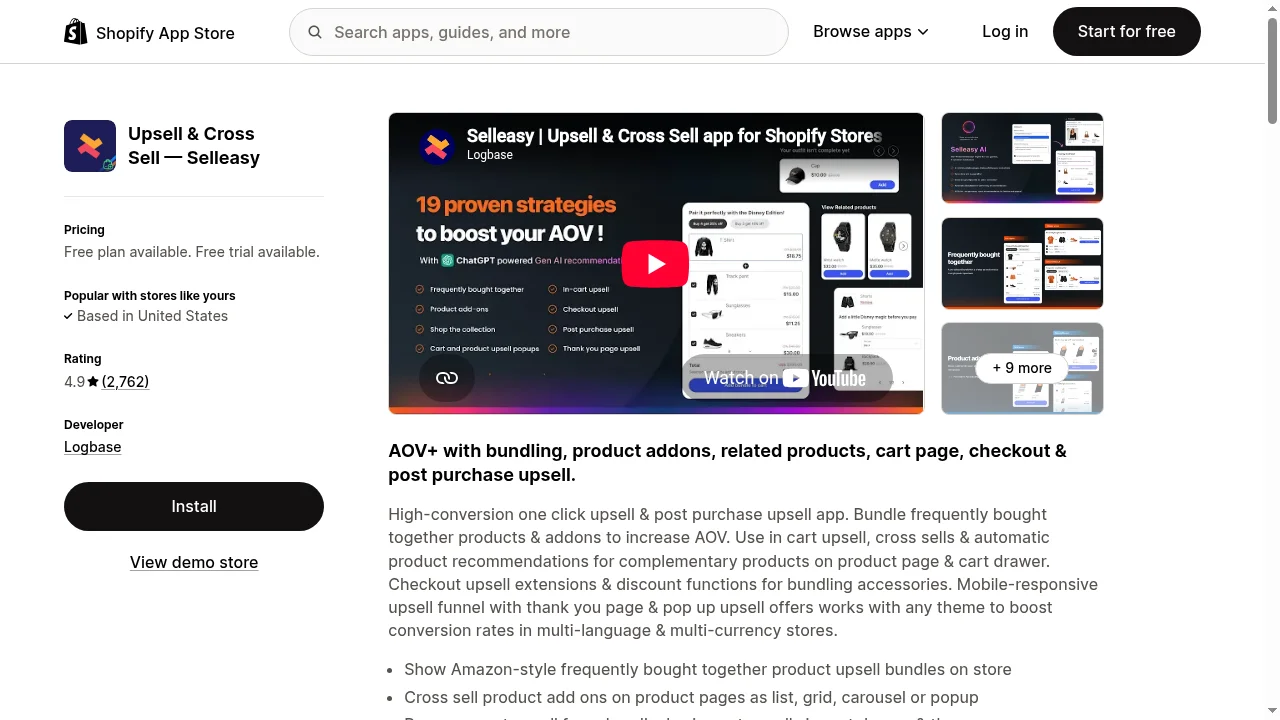
Source: Selleasy on the Shopify App Store.
Selleasy combines product add-ons, frequently-bought-together bundles and offers at several stages of the shopping journey. It is an option for merchants comparing several campaign formats within one app.
- Product-page add-ons displayed as lists, grids, carousels or pop-ups.
- Cart offers, one-click post-purchase offers and thank-you/order-status recommendations.
- Manual, Shopify and AI recommendation options, with allowances varying by plan.
- Advanced targeting and checkout upsells on eligible plans; embedded checkout upsells require Shopify Plus.
Free includes up to five campaigns and unlimited orders. Starter costs $9/month, with unlimited campaigns and 50 free AI recommendations. Pro is $29/month, listing 1,000 AI recommendations per month; Max is $59/month, listing 2,500. Paid plans show a 30-day trial.
Logbase's official incident update, updated in October 2026, says an attacker used a legacy support tool to place an unauthorized script on affected storefronts. The developer reports same-day containment and cleanup, an Astra Security assessment, and Shopify review followed by re-listing. Those are developer-reported remediation details; we have not independently audited the assessment. Review the current report and your store-specific exposure before installation or reactivation.
A recent positive review praises broad strategy coverage and human support. A customization exchange distinguishes routine styling from store-specific engineering requiring a higher plan. Another October review criticizes incident communication; Logbase's response acknowledged the delay.
Our take: compare it for campaign flexibility, with security due diligence and required customization costs included in the decision.
5. ReConvert — funnel controls and automated setup
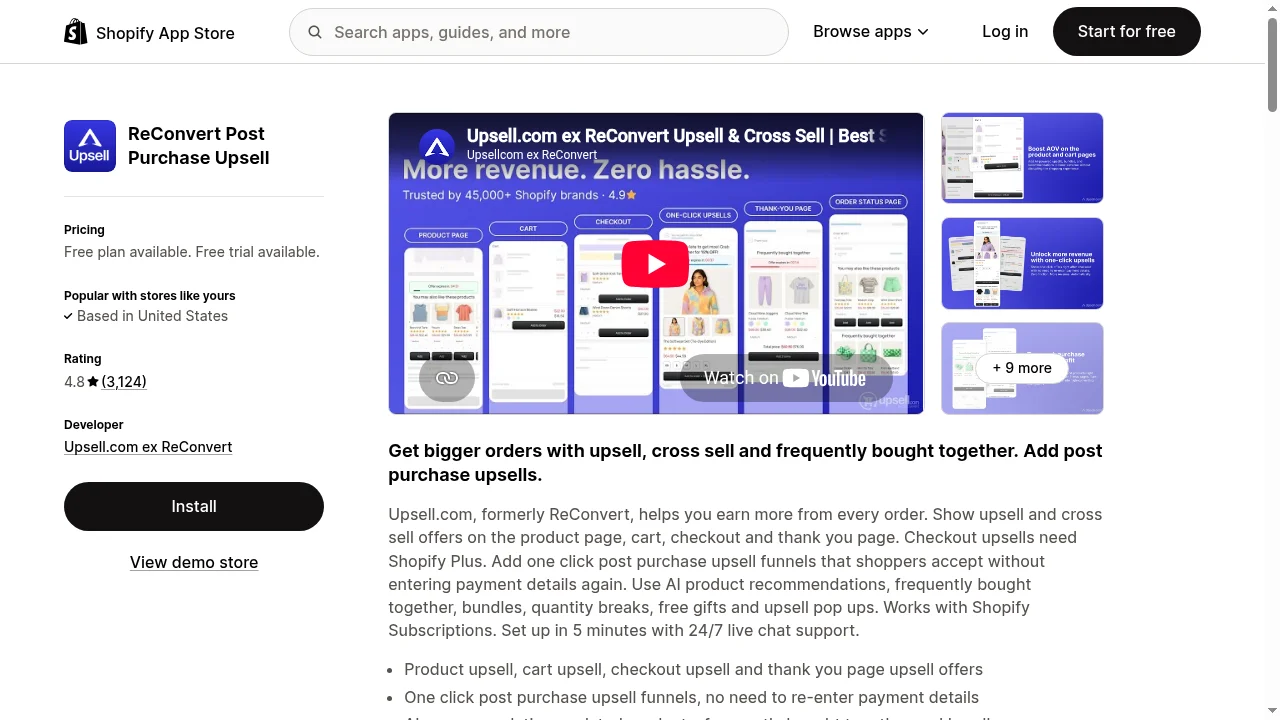
Source: ReConvert on the Shopify App Store.
ReConvert, whose developer is listed as Upsell.com ex ReConvert, offers recommendations and funnel tools across the purchase journey. Its distinction is the combination of targeting, editing and testing controls rather than a single recommendation widget.
- Offers on product pages, in the cart, at checkout and after purchase.
- One-click post-purchase funnels and AI product recommendations.
- Frequently-bought-together offers, bundles, quantity breaks and free gifts.
- A/B testing, analytics, segmentation and a drag-and-drop editor.
The App Store describes Free as “up to 50 orders or $50 upsell revenue.” Displayed Growth tiers are $9.99/month for 51–100 store orders, $19.99 for 101–200 and $39.99 for 201–500, with a 14-day trial.
The developer's pricing page says “monthly store orders or upsell revenue (higher of the two).” Obtain the calculation applicable to your store, including revenue thresholds, automatic changes and higher-volume tiers. Request a quote for your expected volume rather than budgeting from the entry price alone.
Embedded checkout offers require Shopify Plus. Validate the actual product types and gateways you use rather than treating a broad feature list as a compatibility guarantee.
Positive examples praise hands-on setup assistance and AI-assisted campaign creation. Unexpected charges and unclear pricing recur in the sampled critical reviews, including an October trial complaint. Developer replies to other complaints offer account reviews or dispute the explanation; we cannot adjudicate individual invoices from those exchanges.
Our take: consider it for funnel control and automation, after obtaining a clear expected bill for your order and revenue profile.
6. Frequently Bought Together CBB — complementary-product bundles
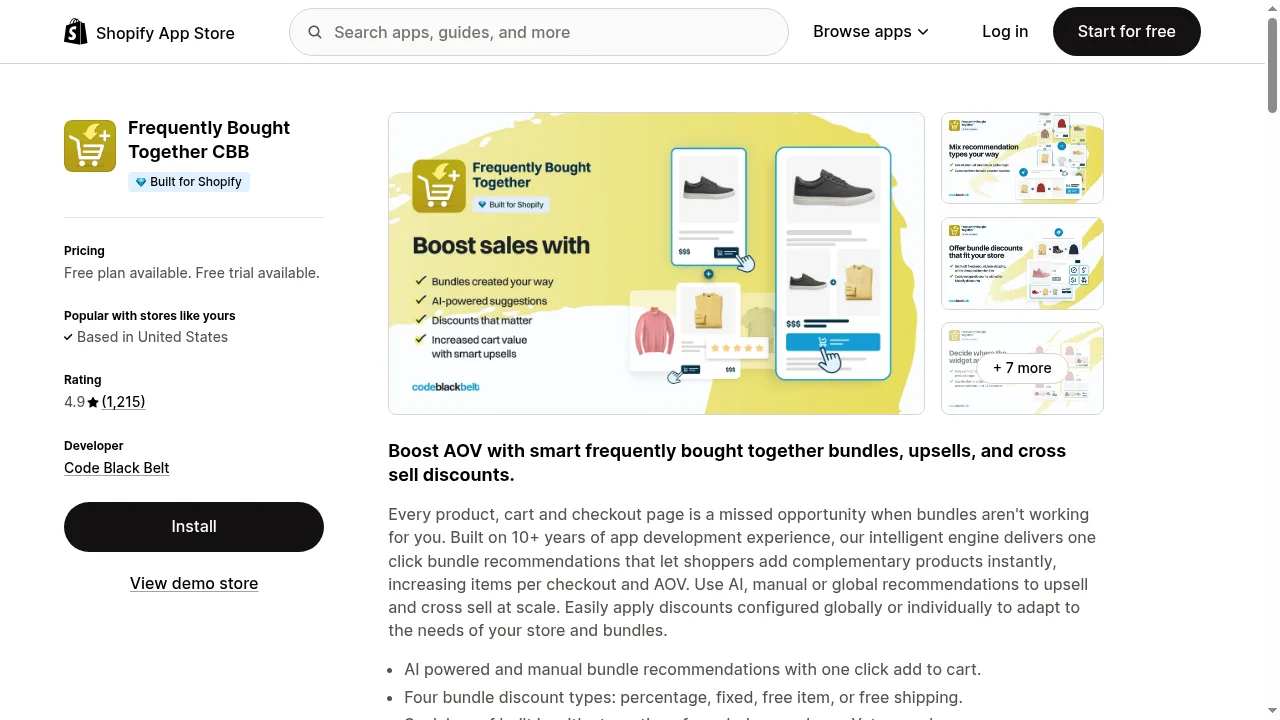
Source: Frequently Bought Together CBB on the Shopify App Store.
Code Black Belt's Frequently Bought Together focuses on helping customers buy related products together. It is relevant for stores that want a curated accessory or complementary-product bundle, rather than a replacement for every stage of the purchase funnel.
- AI, manual and global product recommendations with one-click add-to-cart.
- Percentage, fixed-amount, free-item and free-shipping bundle discounts.
- Customizable recommendation widgets; the current listing advertises product- and cart-page placement.
- Product-rating integrations, including Judge.me, Loox and Yotpo, for social proof.
The free Starter plan allows up to three manual bundles and basic customization. Paid tiers shown are $9.99/month for up to 50 orders, $24.99 for up to 500 and $39.99 for 500+ orders, with a 14-day trial. Paid plans add unlimited manual bundles, automatic/global recommendations, discounts and other tools.
Decide whether the basic free widget meets your needs or whether you require the paid recommendation toolkit. Verify the present version's placement options: an older developer reply described product-page-only behavior, while the current listing now advertises cart placement. That historical reply should not be presented as a current restriction.
Recent review examples include praise for service. Critical feedback concerns free-tier flexibility and difficulty creating manual bundles. In the latter exchange, the developer supplied setup documentation and offered assistance. Test the recommendation quality with your own catalog instead of assuming automatic suggestions will be suitable.
Our take: a focused candidate for complementary bundles, particularly when you want to curate the products and discount structure yourself.
7. Aftersell — post-purchase funnels with separate pre-purchase options
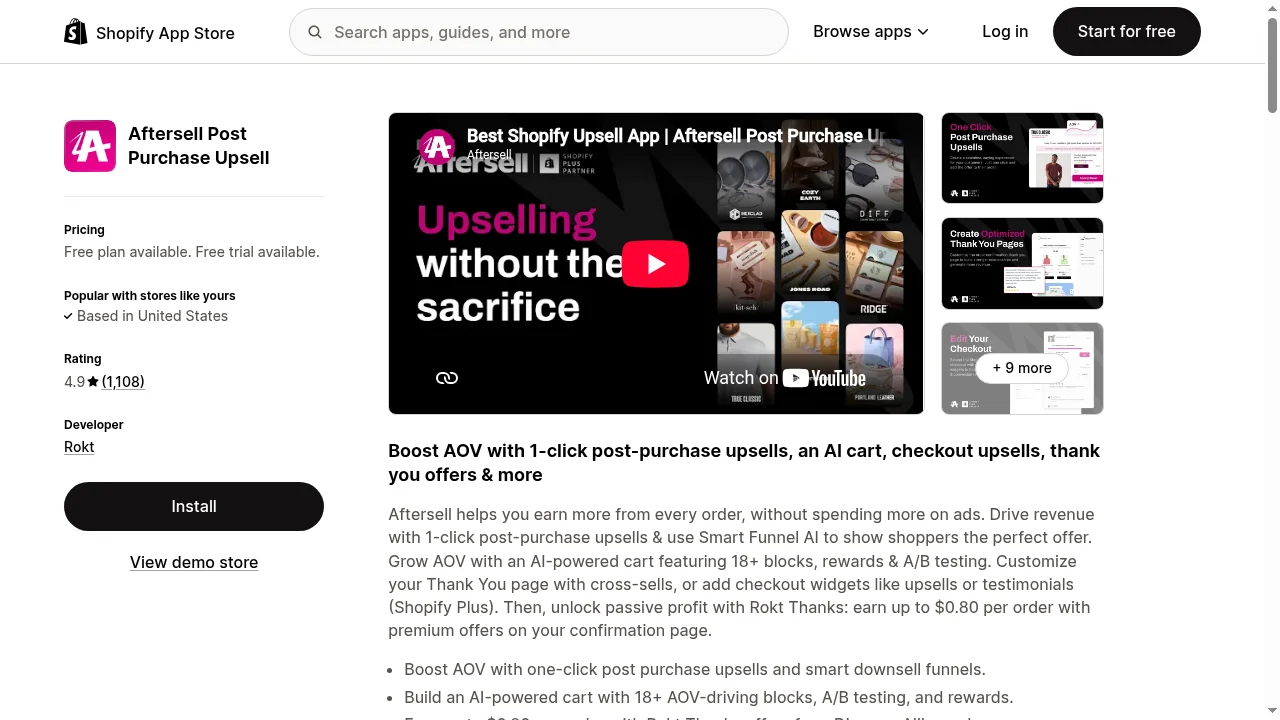
Source: Aftersell on the Shopify App Store.
Aftersell by Rokt combines post-purchase funnels with optional pre-purchase tools. Its package structure matters: buying post-purchase functionality does not mean the cart-building package is included at the same starting price.
- One-click post-purchase offers, smart funnels and downsell flows.
- An AI-powered cart with configurable blocks, rewards and product-page offers in the pre-purchase package.
- Targeting, analytics and testing tools, with capabilities depending on the package.
- Thank-you-page offers and checkout widgets; embedded checkout customization requires Shopify Plus.
The listing shows Post-Purchase at $34.99/month, Pre-Purchase at $59.99 and Complete at $79.99, with a 30-day trial. Free access is limited to development and partner stores.
The developer's pricing calculator also uses total monthly store orders. Treat the displayed prices as starting points, not flat quotes for every order volume. Confirm the chosen package, volume adjustment and any other applicable charges before approving billing.
Match the package to the placement you intend to use. A post-purchase funnel and a thank-you-page offer are separate experiences with different controls. Verify that the specific page and payment path you need are eligible before judging the app by the overall feature list.
Sampled positive reviews emphasize setup assistance and fast support. One positive October review also describes thank-you-page functionality as comparatively limited. A separate October reviewer reports PayPal checkout failures after installation. We have not reproduced that issue: it is a reason to test that payment path, not evidence of universal PayPal incompatibility. Critical reviews also raise pricing concerns.
Our take: compare it for post-purchase funnels, while budgeting separately for pre-purchase tools and your actual store-order volume.
8. Honeycomb — multi-placement funnels and split testing
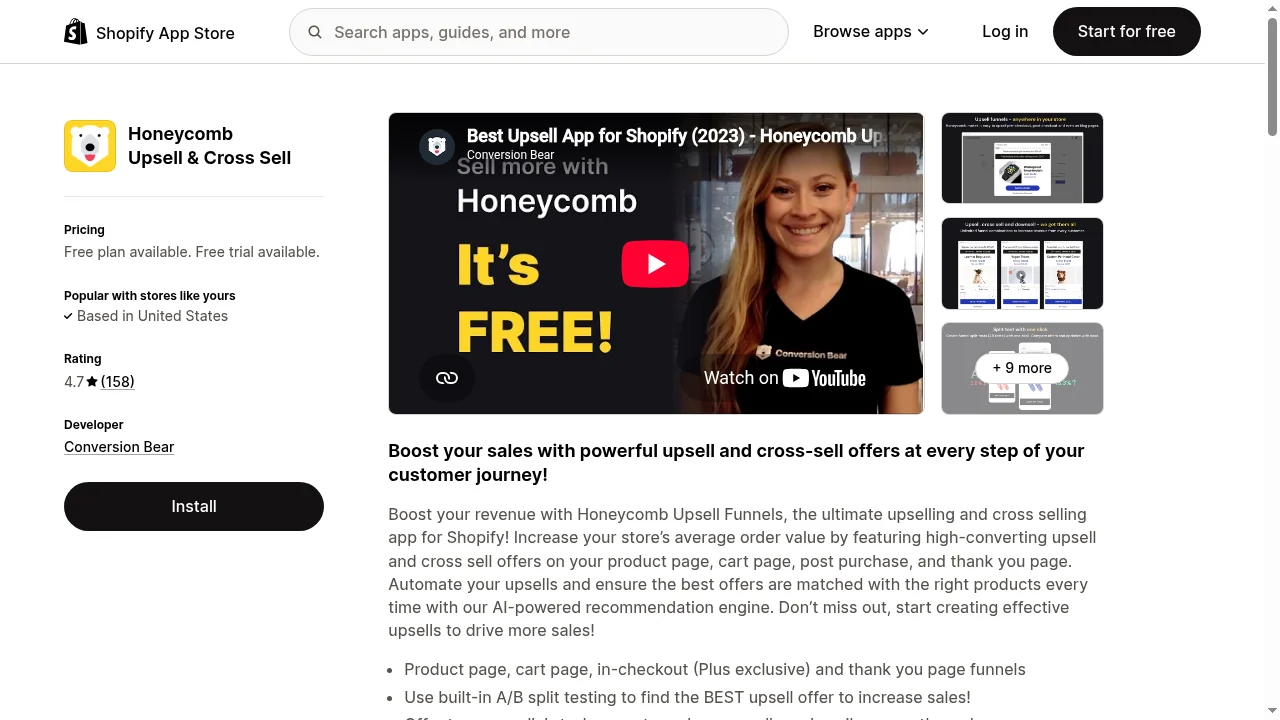
Source: Honeycomb on the Shopify App Store.
Honeycomb provides offer funnels across several stages of the purchase journey. Its view-based pricing is a useful distinction: a campaign's audience size affects the plan even when the number of accepted offers is small.
- Product-page, cart-page, post-purchase and thank-you-page offers.
- One-click post-purchase upsells, with checkout placement listed as Shopify Plus-exclusive.
- AI-powered recommendations and an autopilot option for matching offers to products.
- Built-in A/B split testing and design controls for the funnel experience.
Free includes 100 monthly funnel views. Displayed paid tiers are $54.99/month for 2,000 views, $109.99 for 5,000 and $169.99 for 10,000. Paid tiers list branding removal and a 7-day trial.
Budget against funnel views rather than successful upsells alone. Confirm how views are counted, what happens when the allowance is exhausted, and whether a larger-volume plan is needed.
A funnel can introduce extra steps or visual interruptions, so choose placements deliberately. Custom design controls do not mean every bespoke behavior will be supported. Ask about the exact customization or tracking integration you need before committing to a particular funnel design.
A January 2026 review praises easy installation, while a longer-term user's review praises support. In contrast, a June 2026 review reports a bug affecting upsells and frustration with the investigation time. Older critical reviews also describe technical problems. These accounts span different versions and stores; they are not a measurement of the current defect rate.
Our take: consider Honeycomb for configurable funnels and split tests, after checking the view allowance and validating the flow on your storefront.
Launch checklist
Before enabling offers for every visitor:
- Choose one useful offer and one placement; avoid adding overlapping prompts from several apps.
- Confirm variants, stock availability, discounts, gift quantities and add-on removal behavior.
- Check mobile presentation, translated URLs and important storefront languages.
- Test accepted and declined offers, standard add-to-cart and accelerated checkout separately.
- Complete test orders with your actual gateways, wallets, currencies and relevant order types.
- For post-purchase offers, check Shopify's platform eligibility rules. Certain payment methods, currencies and delivery arrangements can prevent the page from appearing.
- Review incremental profit, checkout conversion, refunds and shipping costs—not just app-attributed revenue.
- Confirm trial dates, automatic tier changes, usage limits and the bill at your expected volume. Understand how to disable offers and uninstall the app if the test does not meet your criteria.
For pre-orders or deposits, keep payment timing and shipping promises visible when recommending add-ons. An available accessory should not appear to share the pre-order's delivery date unless that is genuinely the fulfillment plan. None of the comparisons above establishes tested compatibility with K1 or every mixed-cart setup.
FAQ
An upsell moves a shopper to a higher-value version, such as a larger pack. A cross-sell adds a complementary item, such as a case for a device. Several apps here support both; the practical question is which offer is useful in your catalog.
Not for every type of offer. Product-page, cart and post-purchase experiences are different from offer blocks inside checkout. Check the exact placement and plan requirements in the relevant app section rather than treating “checkout” and “after checkout” as interchangeable.
Some are, within their stated allowances. Others are restricted to development or trial stores. Compare the eligibility and billing triggers in each pricing section, not just a “Free plan available” badge.
Shopify lets you select one app for the post-purchase offer page. Other apps may still handle different placements, but test the full journey for duplicate offers and conflicting cart behavior.
Start with the workflow table, then read the relevant app's limitations and review examples. A store replacing its cart drawer has different needs from one building an after-payment funnel. Price, operational fit and the ability to test safely matter more than position in this list.
Conclusion
There is no universal winner for every Shopify store. Candy Rack is our featured option for managing multiple placements and a slide cart together. The alternatives offer different routes: a cart-focused setup, a recommendation widget, a complementary bundle or a configurable funnel.
Pick the workflow first, understand the charging unit, and validate the complete purchase experience. A larger order helps only when the customer completes it and the additional sale makes financial sense.