TL;DR
Choosing between a deposit and full payment is not only a billing decision. It also determines what customers need to understand before placing a pre-order.
Full payment can be straightforward when the expected wait is short and the total price is manageable. A deposit or partial payment may make a longer or higher-value pre-order feel more accessible by reducing the amount due upfront.
Whichever model you choose, communicate three things clearly before checkout:
- the amount charged today;
- the remaining balance;
- the date or schedule for collecting it.
Clear, repeated messaging can help customers recognize later charges and reduce avoidable questions, cancellations, and payment disputes.
Deposit vs. full payment vs. partial payment
A full-payment pre-order charges 100% of the price at checkout, even though the product will be delivered later.
A deposit-based pre-order charges a percentage or fixed amount at checkout. The remaining balance is collected later according to the merchant’s configured payment schedule.
A partial-payment pre-order follows the same basic principle but often uses a fixed upfront amount rather than a percentage. For example, a customer might pay $50 today and the remaining $150 on a specified date.
These models primarily change when the customer pays—not necessarily the final product price.
Extra or unexpected costs are already a major source of checkout friction. According to Baymard Institute, 39% of surveyed shoppers who abandoned an order cited high additional costs. Although that research is not specific to pre-orders, it reinforces a useful principle: customers should understand the complete financial commitment before placing an order.
Comparing the payment models
There is no universal payment model for every pre-order campaign. The best choice depends on the product price, expected fulfillment window, margins, customer expectations, refund policy, payment-method support, and applicable consumer-protection requirements.
| Model | How it works | Situations to consider | Main communication need |
|---|---|---|---|
| Full payment | The complete price is charged at checkout | Shorter, more predictable waits or lower-priced products | Make the estimated delivery timing prominent |
| Percentage deposit | A percentage is charged now and the balance later | Longer waits or higher-value products | State the percentage, monetary amount, and balance schedule |
| Fixed partial payment | A fixed amount is charged now and the remainder later | Products where a simple upfront amount is easier to explain | Show both monetary amounts clearly |
| Pay later | A supported payment method is stored securely for a later charge | Campaigns with predictable payment timing and supported payment methods | Explain when the charge is expected and send a reminder |
The examples above are starting points, not universal benchmarks. Merchants should test the approach against their own products, policies, customers, and payment setup.
How to communicate pre-order charges clearly
1. Show the amount due today and the remaining balance
Do not make customers calculate the payment split themselves. Place the information on the product page and repeat it in the cart or checkout experience where supported.
For example:
Pay a $50 deposit today. The remaining balance is $150 and is scheduled for collection on October 23, 2026. We’ll remind you before the payment is collected.
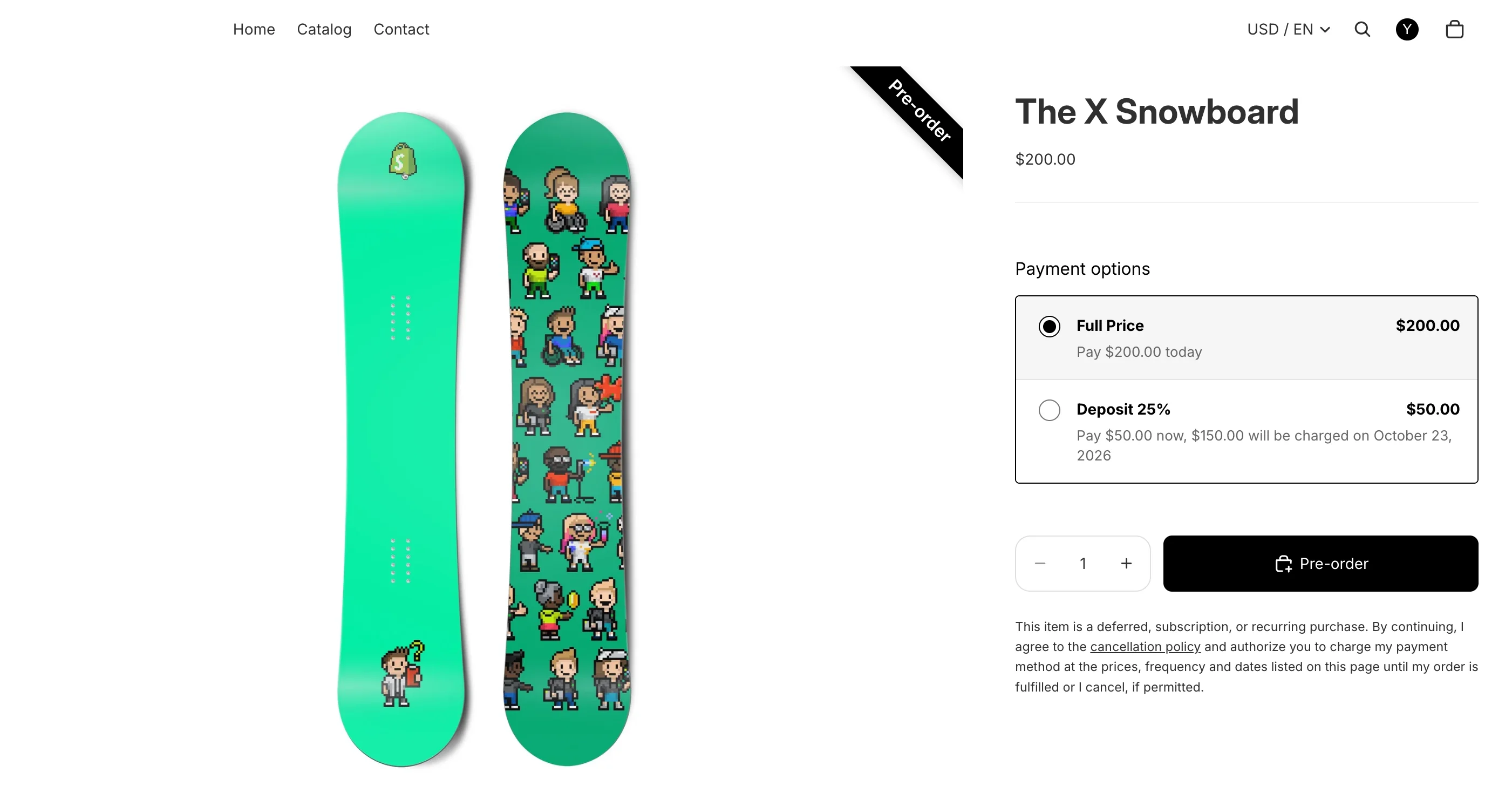
Storefront payment options configured with K1 PreOrder Now & Deposit: pay the full $200 or pay $50 now, with the remaining $150 shown before purchase.
If the collection date could change, explain what determines the schedule and how customers will be notified.
2. Repeat the payment plan in the order confirmation
The order confirmation should restate:
- the total product price;
- the amount already collected;
- the outstanding balance;
- the scheduled collection date or payment terms;
- the cancellation and refund policy.
A customer may not remember every detail shown during checkout. Repeating the plan gives them a reliable record to return to later.
3. Help customers recognize the charge
Where the merchant’s payment-provider configuration allows it, the billing descriptor should be recognizable and consistent with the store identity.
An unfamiliar descriptor can make a legitimate charge harder to recognize. Merchants should review the options available through Shopify Payments or their payment provider rather than assuming the descriptor can always be changed freely.
4. Send a reminder before collecting the balance
A pre-charge reminder can help customers prepare for and recognize the payment. The ideal timing depends on the product, payment schedule, and customer journey; several days before collection can be a useful starting point.
For example:
Your pre-order balance of $150 is scheduled to be collected on October 23. You can review your order and payment details here: [order link].
Avoid saying that the balance will be charged “when the order ships” unless that behavior is actually supported and configured. A specific date or clearly defined schedule is easier to verify and communicate.
5. Make answers easy to find
Pre-order customers often ask similar questions:
- When will my order ship?
- How much have I paid?
- When is the remaining balance due?
- Can I update or cancel the order?
- What happens if the estimated date changes?
- What is the refund policy?
An AI support tool can help answer repetitive questions across supported channels, provided that it has access to the necessary order and policy information. Complex cases, sensitive refund requests, and exceptions should still have a clear path to a human support agent.
Zipchat provides AI-assisted customer support across multiple channels. According to Zipchat’s published customer stories, Family Nation automated 80% of customer inquiries and Tropicfeel automated 85%. These results are not specific to pre-orders, but they illustrate how repetitive support questions can be handled before they reach a person.
Deposit math: a simple example
The calculation itself is straightforward:
Deposit amount = Unit price × Deposit percentage Remaining balance = Unit price − Deposit amount
For a $200 pre-order with a 25% deposit:
- Deposit today: $200 × 0.25 = $50
- Remaining balance: $200 − $50 = $150
The customer pays $50 upfront instead of the full $200. The merchant should then show exactly when and how the remaining $150 is expected to be collected.
Deposit percentages such as 10%, 25%, or 50% should be treated as illustrative options—not default recommendations. The appropriate amount depends on factors such as production costs, lead time, product value, cancellation exposure, customer expectations, and local requirements.
Choosing a starting point
The following framework can help merchants evaluate their options. It should not be treated as a universal rule.
| Situation | Option to evaluate | Questions to ask |
|---|---|---|
| Short and predictable wait | Full payment | Is the delivery estimate reliable and clearly displayed? |
| Longer wait | Deposit or partial payment | Would a lower upfront amount make the commitment easier to understand? |
| Higher-priced product | Deposit or staged payment | How much can the customer reasonably commit upfront? |
| Made-to-order product | Larger deposit may be considered | Are cancellation terms clear and legally appropriate? |
| Uncertain availability date | Delay the sale or use flexible terms | Can the merchant communicate changes and process refunds promptly? |
A deposit should not be presented as non-refundable by default. Whether a deposit can be treated as non-refundable depends on the merchant’s published policy, applicable consumer-protection rules, and local law. Merchants should obtain appropriate legal guidance before using non-refundable deposit terms.
Where pre-order messaging often breaks
| Customer symptom | Possible contributor | Action to consider |
|---|---|---|
| Questions increase near the balance date | The later charge was not repeated after checkout | Send a reminder that includes the exact amount and date |
| A customer does not recognize the charge | The descriptor differs from the store identity | Review the available descriptor settings with the payment provider |
| Customers ask whether they were charged twice | Deposit and balance appear without enough context | Show both transactions as parts of the same payment plan |
| Customers cancel soon after ordering | The payment commitment or wait was not clear | Improve the pre-purchase explanation and evaluate another payment model |
| Support receives repeated shipping questions | The delivery estimate is difficult to find | Add a visible order-status page and automated answers with human escalation |
These are diagnostic possibilities, not guaranteed causes. Merchants should review actual customer conversations, cancellation reasons, and payment data before changing the payment model.
When a deposit may not be the best option
A deposit adds another payment event to the customer journey. That additional step may not be worthwhile in every situation.
The fulfillment window is short. If the product is expected to ship soon, full payment may be easier for both the merchant and customer.
The product price is low. Splitting a small purchase can create unnecessary complexity. Merchants should also check how their payment provider handles transaction fees before assuming that multiple charges will cost the same as one.
The availability date is highly uncertain. A deposit does not solve unreliable supply or communication. If the date changes, customers need prompt, transparent updates and access to the published cancellation or refund process.
The merchant cannot send reliable payment reminders. Before enabling later balance collection, make sure customers can be notified and can access accurate order information.
Setting up deposits and partial payments on Shopify
Shopify provides the underlying selling-plan and deferred-payment infrastructure, but merchants typically use a dedicated app to configure pre-orders, deposits, payment schedules, and customer-facing information.
With K1 PreOrder Now & Deposit, merchants can configure full payment, percentage-based deposits, or fixed partial payments. Depending on the setup and supported payment method, the remaining balance can be collected automatically on a configured date or a set number of days after the order. Merchants can also manage manual or offline balance collection.
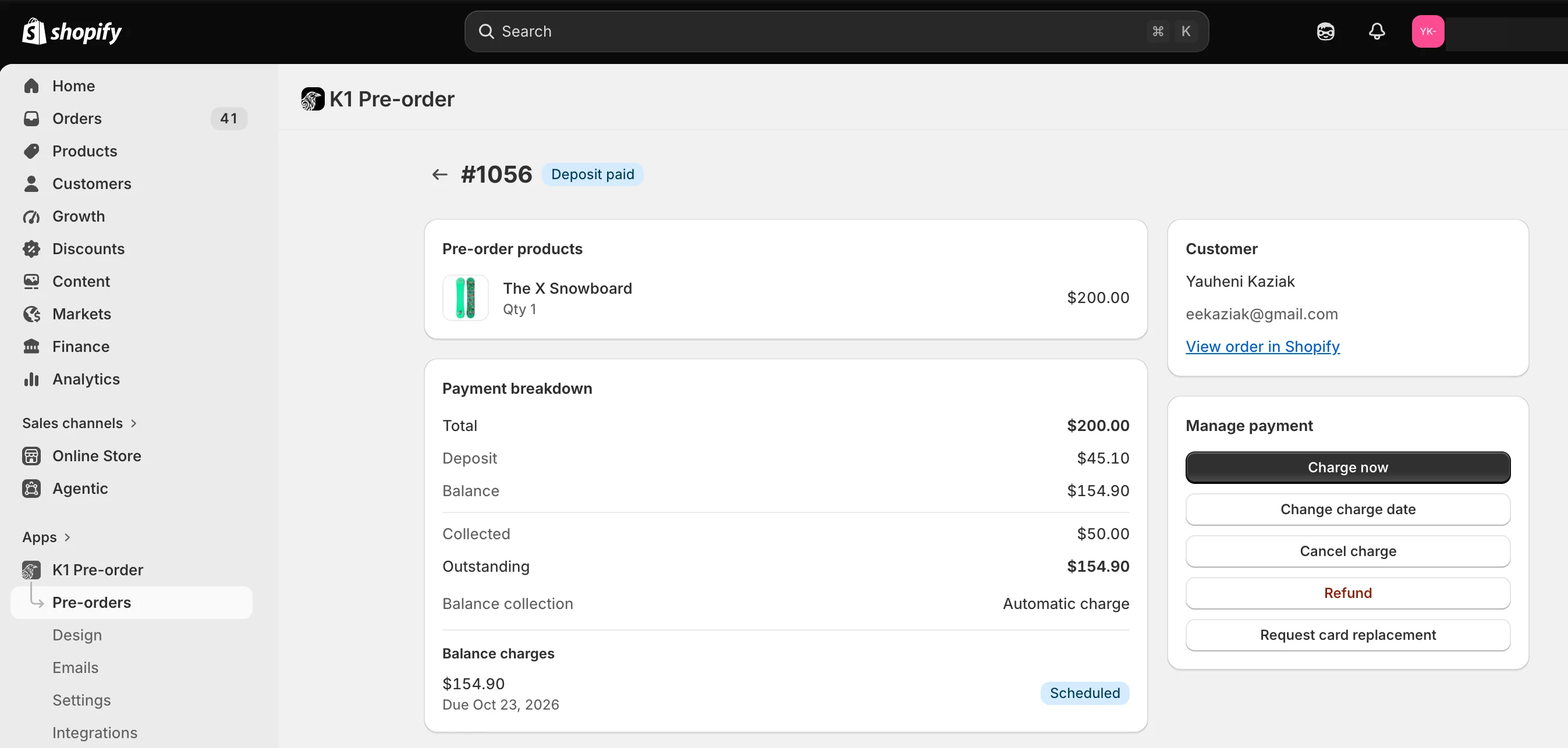
Order-level payment record configured through K1 PreOrder Now & Deposit: $50 collected at checkout, $154.90 outstanding, and automatic balance collection scheduled for October 23, 2026.
The supported payment method is stored securely by Shopify for later collection; K1 does not directly hold customers’ card data.
This creates a practical division of responsibilities:
- K1 configures what the customer pays and when the remaining balance is due.
- The storefront and lifecycle messages show the payment plan before and after checkout.
- An AI support layer such as Zipchat can help explain the plan and answer repetitive questions where the required order and policy data is available.
- The human support team handles exceptions, sensitive requests, and cases requiring judgment.
This combination can make a long pre-order window easier to manage without presenting automation as a replacement for clear policies or human support.
FAQ
Should I take a deposit or full payment on a pre-order?
Consider full payment when the wait is short, predictable, and proportionate to the product price. Evaluate a deposit or partial payment when the wait is longer or the upfront commitment may feel substantial. The final decision should also account for margins, refund policy, payment-method support, customer expectations, and applicable regulations.
How much should a pre-order deposit be?
There is no universal percentage. Values such as 10%, 25%, or 50% can be tested as starting points, but the appropriate deposit depends on the product price, production commitment, lead time, cancellation exposure, and customer expectations. The amount due today and the remaining balance should always be shown in monetary terms—not only as percentages.
How can I help customers recognize a later pre-order charge?
Show the complete payment plan before checkout, repeat it in the confirmation, use a recognizable billing descriptor where supported, and send a reminder before collecting the balance. Unexpected or unrecognizable charges may increase customer questions and payment disputes.
Can Shopify handle pre-order deposits on its own?
Shopify provides selling-plan and deferred-payment capabilities, but merchants generally use an app to configure the pre-order offer, deposit amount, collection schedule, and customer-facing experience. The exact features available also depend on the payment method and store configuration.
Can the remaining balance be charged automatically when the order ships?
K1 supports automatic balance collection on a configured date or a set number of days after the order, depending on the setup and supported payment method. It should not be described as automatically charging from a fulfillment or shipping event unless that specific behavior has been separately verified.
How can I reduce support tickets during a long pre-order window?
Make the estimated delivery timing, amount paid, remaining balance, payment schedule, cancellation terms, and refund policy easy to find. Automation can handle repetitive questions where accurate data is available, while a human escalation path should remain available for exceptions.
Start with clarity, not a universal rule
The right payment model depends on the product and customer—not on a fixed threshold copied from another store.
Choose a model that fits the price, expected wait, operational risk, and payment setup. Then communicate the amount due today, the remaining balance, and the collection schedule consistently across the product page, checkout experience, confirmation, reminders, and support channels.
One practical setup combines a pre-order payment app that manages the deposit and balance with an AI support layer that helps customers understand the arrangement. Clear payment terms and reliable follow-up can make a long pre-order window easier for both the merchant and the customer.
Guest author: Akinwale Ojo, Content Strategist at Zipchat
Akinwale Ojo is a content strategist with more than six years of experience in SEO and technical content writing. He helps B2B, B2C, and SaaS companies turn complex product insights into clear, search-optimized content.
